

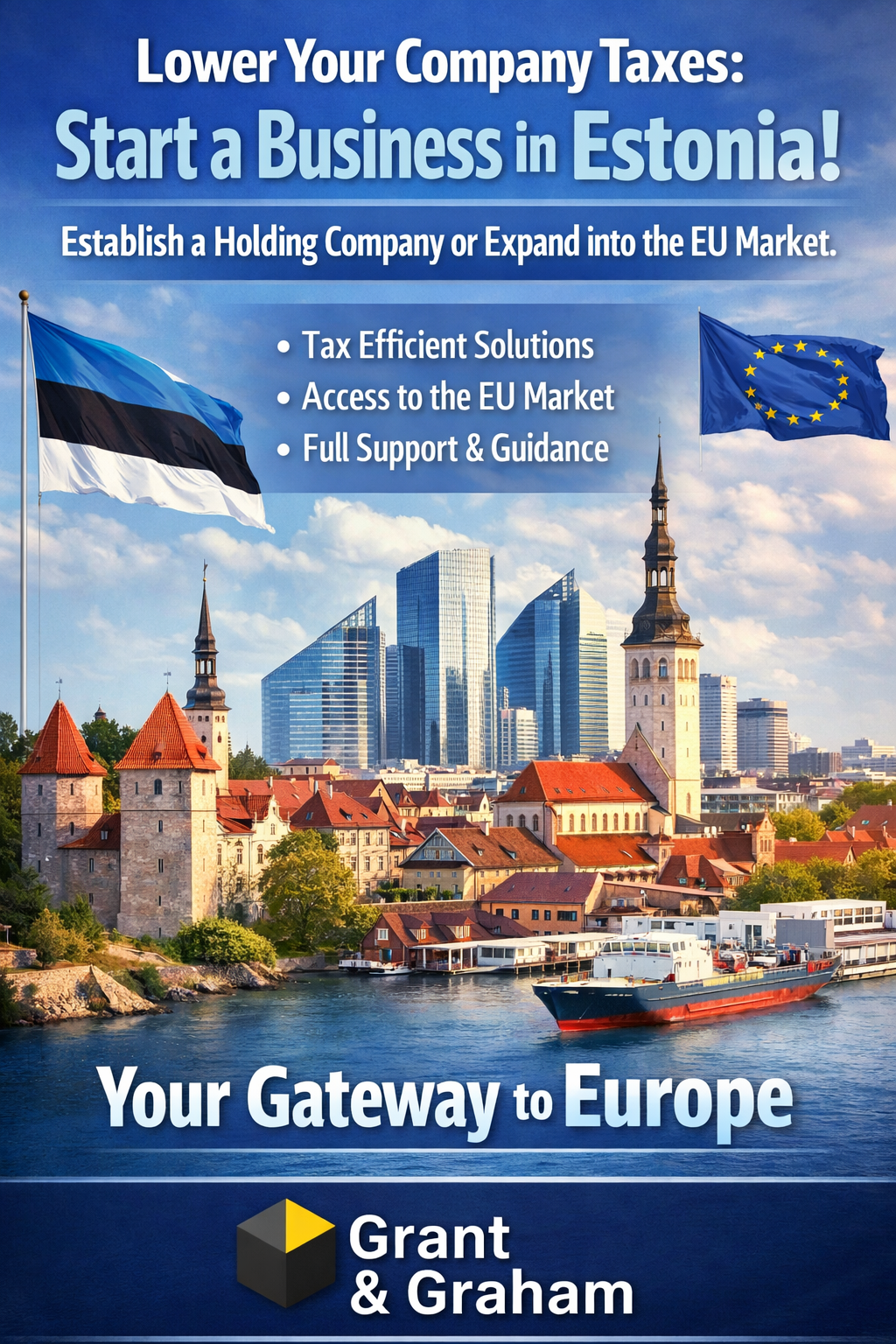
 For founders and business owners operating outside the EU, structuring a company that is tax-efficient, compliant, and future-proof is becoming increasingly complex. Rising corporate taxes, regulatory fragmentation, and cross-border friction are pushing many organisations to rethink how—and where—they operate.
One jurisdiction consistently standing out is Estonia.
Not as a loophole, but as a strategically designed business environment built for international entrepreneurs, digital companies, and modern holding structures.
Estonia’s Corporate Tax Model: Designed for Growth, Not Extraction
Estonia operates a unique corporate tax system within the EU. Profits are not taxed when they are earned, but only when they are distributed.
What this means in practice:
-
Profits reinvested into the business are not subject to corporate income tax
-
Cash can be used to grow operations, fund expansion, or strengthen reserves
-
Tax is triggered only at the point of dividend distribution
For founders focused on scaling rather than short-term extraction, this model offers a structurally different incentive compared to most European jurisdictions.
An Ideal Jurisdiction for Holding Companies
Estonia is particularly well-suited as a holding company jurisdiction, especially for entrepreneurs with:
-
Multiple operating companies across countries
-
IP-driven or digital business models
-
International revenue streams
-
Future exit or acquisition considerations
Key advantages include:
-
EU-compliant legal and tax framework
-
Strong substance rules when structured correctly
-
Access to EU directives (e.g. Parent-Subsidiary Directive, depending on structure)
-
Transparent governance and low administrative burden
When properly designed, an Estonian holding structure can simplify group management, improve capital flow efficiency, and support long-term value creation.
Gateway to the European Union
An Estonian company is a fully recognised EU legal entity.
This provides:
-
Direct access to the EU single market
-
Credibility with European clients, partners, and banks
-
Simplified cross-border contracting within the EU
-
A stable jurisdiction aligned with EU law and regulatory standards
For non-EU founders, this often removes friction when doing business with European customers or entering regulated supply chains.
Digital-First, Founder-Friendly Administration
Estonia is globally recognised for its digital government infrastructure. Through e-Residency and digital company administration:
-
Companies can be managed remotely
-
Board resolutions, filings, and reporting are digital by default
-
Bureaucracy is minimal compared to traditional jurisdictions
-
Compliance is clear, predictable, and transparent
This is not about avoiding regulation—it’s about removing unnecessary friction.
Expansion Into Estonia as an Operating Market
Beyond holding structures, Estonia can also serve as a launchpad for EU operations, particularly for:
-
Technology and SaaS companies
-
Professional services
-
Fintech and platform businesses
-
Digital commerce and cross-border services
With a highly educated workforce, strong English proficiency, and a pro-innovation regulatory mindset, Estonia is increasingly attractive as a real operational base—not just a legal one.
Structuring Matters
It’s important to be clear: Estonia is not a “set-and-forget” solution.
The benefits only work when:
-
The structure matches the business reality
-
Substance, governance, and tax residency are properly addressed
-
Holding vs operating roles are clearly defined
-
Home-country tax implications are fully considered
Poor structuring can eliminate the advantages entirely.
How Grant & Graham Supports This Journey
At Grant & Graham, we work with international founders and leadership teams to:
-
Assess whether Estonia is the right jurisdiction for their goals
-
Design compliant holding or operating structures
-
Support company formation and governance setup
-
Align tax, legal, and commercial considerations across countries
-
Support EU expansion strategies beyond incorporation
Our role is not just incorporation—but strategic structuring.
Estonia Company Formation: Myth vs Reality
As Estonia gains visibility among international founders, misconceptions often follow. Here’s a clear view of what’s myth and what’s reality.
Myth 1: Estonia is a tax haven
Reality:
Estonia is a fully compliant EU jurisdiction with transparent rules and strong regulatory oversight. The advantage lies not in secrecy or avoidance, but in when corporate tax is applied. Profits are taxed only upon distribution, not when reinvested. This model is explicitly designed to encourage long-term business growth.
Myth 2: You don’t pay any tax in Estonia
Reality:
Tax is deferred, not eliminated. Corporate income tax becomes payable when profits are distributed as dividends. Payroll taxes, VAT, and other obligations still apply where relevant. Estonia rewards reinvestment—but expects compliance.
Myth 3: You can run everything anonymously
Reality:
Estonia operates with full transparency. Beneficial ownership is registered, reporting standards are high, and anti-money laundering rules are strictly enforced. This is a jurisdiction designed for legitimate international businesses, not opacity.
Myth 4: An Estonian company automatically solves home-country tax
Reality:
It doesn’t. Personal tax residency, management location, and controlled foreign company (CFC) rules still matter. Estonia works best as part of a properly structured international setup, not as a shortcut. Cross-border alignment is essential.
Myth 5: Estonia is only useful for “paper companies”
Reality:
While Estonia is excellent for holding structures, it is also a real operating environment. Many companies run product development, SaaS platforms, finance, and EU-facing operations directly from Estonia, supported by a skilled workforce and strong digital infrastructure.
Myth 6: You just need e-Residency and you’re done
Reality:
e-Residency is an access tool—not a business strategy. Bank selection, substance, governance, tax planning, and group structure all determine whether the model actually works. Without proper setup, the advantages quickly disappear.
The Bottom Line
Estonia is not a loophole.
It is a strategic jurisdiction—when used correctly.
The real advantage comes from:
-
Thoughtful structuring
-
Alignment with your wider group and personal situation
-
Long-term planning rather than short-term optimisation
That’s where professional guidance makes the difference.
Considering an Estonian holding company or EU expansion?
We’re happy to discuss whether this model fits your business and how to structure it correctly.
📩 uk@grant-graham.co.uk
🌍 www.grant-graham.co.uk
United Kingdom | Netherlands | Estonia | Germany | Italy | Finland | Portugal | Egypt | UAE | USA | Singapore | India