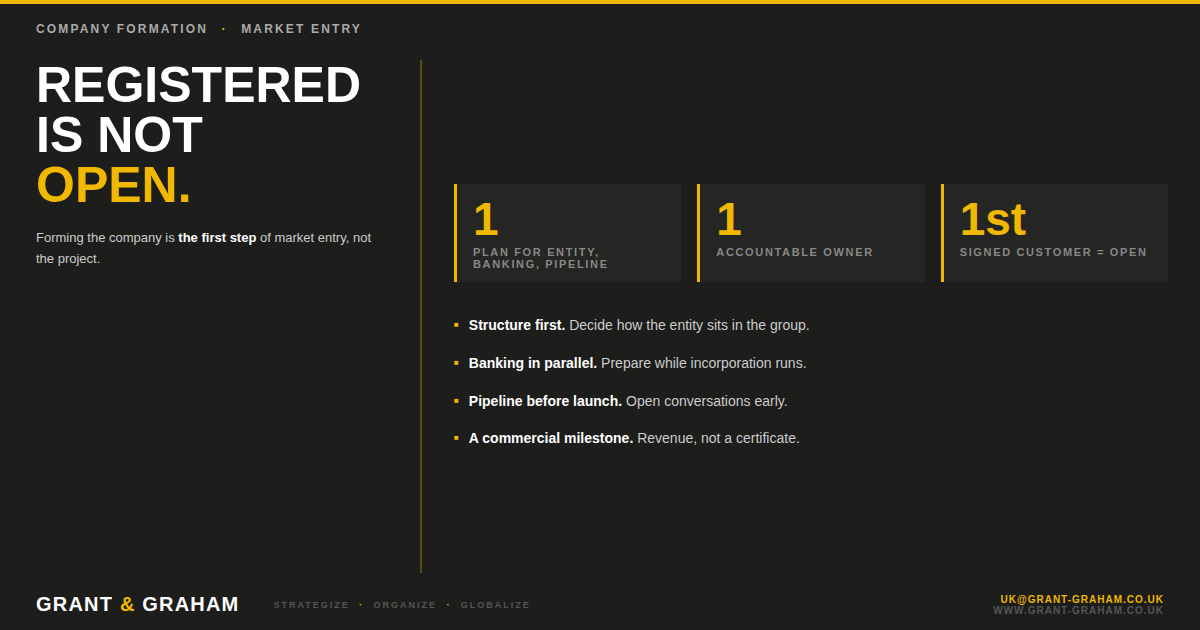
EU Inc, the optional 28th regime company that could be registered online in about two working days for at most €100, cleared the Council on 23 October 2026. It is not available yet: Parliament still has to vote and the rules apply 21 months after entry into force. Founders and groups entering the EU in 2027 should set up now under a national form and build it to convert later.
The Commission tabled the EU Inc proposal on 18 March 2026 as a single, directly applicable regulation, a response in part to the Draghi report on European competitiveness (Pinsent Masons). On 23 October 2026 member states' ambassadors agreed the Council's negotiating mandate (Irish Department of Enterprise, Tourism and Employment). That is real progress, but it is only half of the legislative process, and the Council text is noticeably more cautious than the Commission's original.
What did the Council change in the EU Inc proposal?
The Council kept the headline promise, online registration in about two days for a maximum of €100, but tightened almost everything around it.
- Registration clock: the 48 hour target no longer counts weekends and public holidays (28th Regime tracker).
- Controls: checks are strengthened at every stage, and member states may refuse registration on money laundering, terrorist financing or other criminal grounds under national law (DETE).
- Insolvency: the simplified digital insolvency chapter has been removed, so insolvency stays under national law. Fast track liquidation for solvent companies survives, with added creditor safeguards and greater director liability (Freshfields, 3 November 2026).
- Employee stock options: the EU stock option plan stays, but is limited to companies with up to 750 employees and €150 million turnover (DETE).
- Timing: member states get 21 months after entry into force, against 12 months in the Commission proposal (Pinsent Masons; 28th Regime tracker).
In short, the Council has turned a bold single market vehicle into something closer to a harmonised national company with a common label.
When will EU Inc actually be available?
Not in 2027. The European Parliament's legal affairs committee postponed its vote on 8 October 2026 and no new date has been confirmed; trilogues cannot start until Parliament adopts its position (28th Regime tracker). The political target remains agreement by the end of 2026 (Eubelius).
Our reading: even if that target is met, formal adoption and publication follow, and then the 21 month run in period starts. A business that needs a European entity before late 2028 cannot plan on EU Inc. The final text may also change again in negotiation, as PwC Legal notes when it calls the original proposal "promising but incomplete".
Should we wait for EU Inc or set up an EU company now?
Ask three questions.
- Do you need to contract, invoice, hire or hold a licence in the EU within 24 months? If yes, waiting costs you revenue.
- Will you raise venture capital across several EU countries? This is where EU Inc's standard articles, digital share transfers and stock option plan matter most. Even then, the stock option benefit is now capped at 750 employees and €150 million turnover.
- Is your entity mainly a holding or treasury company? EU Inc does not change tax residence, substance or Pillar Two analysis. A national holding company with real substance remains the tool for that job.
For most clients the answer is to set up now, under a form that already offers fast digital registration, and keep the cap table, articles and governance clean so the company can be reorganised into an EU Inc if the final regulation proves worth it. The Commission proposal already anticipates EU Inc being created as part of a restructuring (Eubelius).
Which EU company form works best today?
| Need | What works now | EU Inc outlook |
|---|
| Fast, fully digital set up | Estonian OÜ, managed remotely through e-Residency | About two working days, but not before late 2028 at the earliest |
| Retaining profits for growth | Estonian OÜ: tax only on distribution, 22/78 with no changes planned for 2026 or 2027 | Tax stays national; no new tax benefit |
| Operating base near customers | Dutch BV or a local national company | Choice of member state, national rules fill gaps |
| Group holding | Estonian or Dutch holding with substance | Holding use not addressed in the proposal |
Estonia's tax figure comes from the official e-Residency programme, which also confirms the e-Residency card fee becomes a flat €165 from 1 January 2027. See our guides to setting up a company in Estonia and holding structures.
What does this mean for UK businesses entering the EU?
EU Inc is open to any business, but under the Commission proposal directors must be natural persons and at least one must be resident in the EU (Eubelius). Combined with the Council's stronger anti money laundering checks, that means UK groups will still need a real EU presence, an EU resident director and clean beneficial ownership records. The same disciplines apply today, as UK companies are also completing Companies House identity verification ahead of the 18 November deadline.
Key takeaways
- The Council agreed its EU Inc mandate on 23 October 2026; Parliament has not voted and trilogues have not started.
- Registration in about two working days for at most €100 survives, with tougher anti money laundering checks.
- Insolvency stays national, and stock option benefits are capped at 750 employees and €150 million turnover.
- With 21 months to apply, do not plan EU market entry around EU Inc before late 2028.
- Set up now under a proven national form and design the structure so it can convert later.
Frequently asked questions
When can I register an EU Inc?
Not yet. The Council agreed its negotiating mandate on 23 October 2026, but the European Parliament has not adopted its position and trilogues have not started. Under the Council text the rules apply 21 months after entry into force, so a realistic first date is late 2028 or later.
Will EU Inc replace the Estonian OÜ or the Dutch BV?
No. EU Inc is an optional extra form that sits alongside national company forms, and the law of the member state of incorporation still fills the gaps. Existing OÜs and BVs remain valid, and the proposal allows an EU Inc to be created as part of a restructuring.
Can a UK company or UK founder use EU Inc?
The form is open to any business, but under the Commission proposal directors must be natural persons and at least one must be resident in the EU. UK groups should plan for an EU resident director and real local substance, as they would for a national EU company today.
Should I wait for EU Inc before entering the EU?
For most businesses, no. If you need an EU contracting entity, bank account, VAT number or employees in the next 12 to 24 months, set up under a proven national form now and keep the structure clean so it can be converted or reorganised later.
How Grant & Graham helps
Grant & Graham Holding in Tallinn and our teams in London, Amsterdam and San Diego set up and run European entities for founders and groups every week. We form companies in 75+ countries, design Estonian and Dutch holding structures with real substance, provide EU resident directors and interim finance leaders, and keep every filing on track with our compliance autopilot. We recently built an Estonian holding structure for a UK healthcare group in six weeks.
If this is on your board's agenda, book a confidential call or see what it would cost.
Sources: Irish Department of Enterprise, Tourism and Employment, EU Inc: Council adopts position, 23 October 2026; Freshfields, Council mandate removes the insolvency chapter, 3 November 2026; Pinsent Masons Out-Law, EU Inc proposal overview, 3 November 2026; The 28th Regime, progress tracker, 7 November 2026; Eubelius, The EU Inc proposal, 14 April 2026; PwC Legal, EU Inc and the 28th regime, August 2026; e-Residency, Changes to e-Residency in 2026 and beyond.